David A. R. Robin
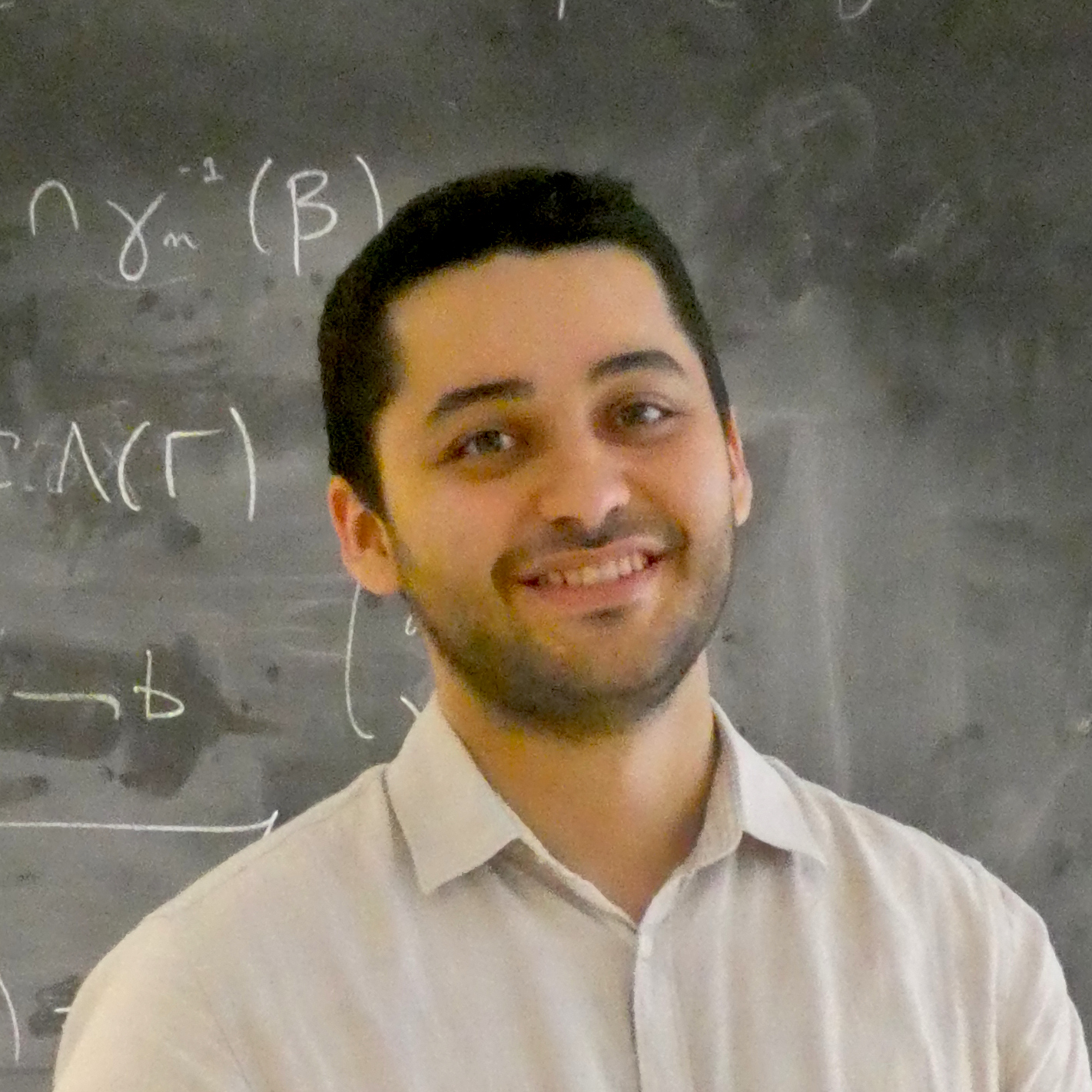
Postdoc at Dauphine University
Machine Learning PhD
News & Upcoming Talks
2026, Oct 30th - Saarland University - Talk in the Mathematical Optimization group2026, Oct 08th - INRIA, Lille - Talk in the MAGNET Team Seminar2026, Oct 01st - ENSI Caen - Talk in the Séminaire Image of GREYC2026, Sep 30th - University of Zurich - Talk in the Department of Mathematical Modeling2026, Jul 22nd - ICTP, Trieste - Presentation of Stab-SGD at Youth in High Dimension2026, Jul 06th - Montpellier - Presentation of Stab-SGD at the CAp Conference2026, Jun 24th - Rennes - Presentation of Adversarial Training results at PEPR IA Days2026, May 18th - ISTA, Vienna - Talk in the group of Marco Mondelli
Publications & Preprints
-
Adversarial Training cannot be reduced to regularization
Preprint, ArXiv 2606.21488
The equivalence between adversarial training and a neat parameter-shrinking regularization for linear models (Ribeiro et al, 2023) had raised hopes that a similar link would exist in non-linear models or in neural networks. We show that no such equivalence is possible, even in two-layer models, a fortiori hopeless in broader cases.
Full text : [ ArXiv ]
-
Precise Convergence Speed of Clip-SGD
Preprint, ArXiv 2609.29458
Tightened convergence analysis of clipped stochastic gradient descent on (L0, L1)-smooth functions, with precise non-asymptotic rates and explicit constants, to produce falsifiable predictions and hyperparameter prescriptions.
Full text : [ ArXiv ]
-
Stab-SGD: Noise-Adaptivity in Smooth Optimization with Stability Ratios
NeurIPS 25, Neural Information Processing Systems, San Diego, 2025
DAR Robin, K. Bakong, K. Scaman
A variant of SGD computing the stability ratio (relative noise level) of gradient estimates to automatically compute a scheduler to shrink step-sizes, with proofs of adaptivity in expectated loss last-iterate loss values, matching nearly all best rates of SGD with noise-tuned schedulers.
Full text : [ OpenReview ]
-
Random Sparse Lifts: Construction, Analysis and Convergence of finite sparse networks
ICLR 24, International Conference on Learning Representations, Vienna, 2024
DAR Robin, K. Scaman, M. Lelarge
Proof of convergence of finite-width multi-layer networks (and transformer-likes) to arbitrarily low loss values by gradient flow, when initialization is diverse and sparse enough. This shows that Probable-Approximate-Correctness is a type of structural guarantee that is achievable for large neural networks of essentially any architecture.
Full text : [ OpenReview ]
-
Convergence beyond the overparameterized regime with Rayleigh quotients
NeurIPS 22, Neural Information Processing Systems, New Orleans, 2022
DAR Robin, K. Scaman, M. Lelarge
Proof of convergence of two-layer neural networks of finite width to arbitrarily low loss values under gradient flow. Without over-parameterization assumptions and thus stronger than infinite-width simplifications, this is achieved by integration of Kurdyka-Lojasiewicz inequalities, a technique to show optimal convergence even without convexity.
Full text & code : [ OpenReview ] [ Github ]
-
Periodic Signal Recovery with Regularized Sine Neural Networks
NeurIPS 22, Neural Information Processing Systems, NeurReps Workshop, New Orleans, 2022
DAR Robin, K. Scaman, M. Lelarge
Neural networks fail to learn periodic functions of unknown frequency, even with sine-like activations, despite previously claimed fixes. Obstructions identified include need for a more diverse (non-vanishing high-variance) init and non-convex sparsity-promoting regularization. With both, perfect recovery far outside the training interval.
Full text & code : [ OpenReview ] [ Github ]
-
Attacking and Fixing the Android Protected Confirmation Protocol
Euro S&P 25, IEEE European Symposium on Security and Privacy, Venice, 2025
M. Arapinis, V. Danos, M. Racouchot, DAR Robin, T. Zacharias
Android's Protected Confirmation (APC) protocol exhibits two vulnerabilities in its communication with the Trusted Execution Environment, leading to a possible bypass of user consent, shown on Google's Pixel. Patching both leads to a provably correct protocol with intended APC user-consent guarantees, in the Universal Composability framework.
Full text : [ HAL ] [ CISPA Link ]
-
Return-oriented programming on RISC-V
ASIA CCS 20, ACM Asia Conference on Computer and Communications Security, Taipei, 2020
GA Jaloyan, K. Markantonakis, RN Akram, DAR Robin, K. Mayes, D. Naccache
Prefix-code machine instructions allow hiding malicious instructions using unaligned jumps, crafting sequences of long (32-bit) instructions whose last 16 bits are either a valid instruction or a valid prefix that can be chained into overlapping sequences fooling ROP gadgets detectors. A tree-based detection method identifies them correctly.
Full text : [ ACM Link ] [ ArXiv ]
Latest Positions
-
Postdoc : Adversarial Training
July 2025 - present, Dauphine University, Paris. LAMSADE / MILES team
with Yann Chevaleyre (LAMSADE, Dauphine) and Rafaël Pinot (LPSM, Jussieu)
-
PhD in Mathematics
Oct 2021 - Jun 2025, INRIA - ENS, Paris. DYOGENE / ARGO Project-team
Advised by Marc Lelarge and Kevin Scaman
Construction and convergence of provably-correct neural networks.
Teaching
-
Teaching Assistant : Deep Learning
Deep Learning (MAP583) course by Kevin Scaman (INRIA - ENS), École Polytechnique
Practical introduction to deep learning and all implementation details, with a focus on coverage of a large amount of different data domains and network architectures.
Resources : [ Synapses page ] [ Practicals repository ] [ Custom python package ]
-
Guest Lecture : Neural network compression
Deep Learning course by Marc Lelarge (INRIA - ENS), ENS Paris
Introduction to neural network compression concepts and recent results, with a focus and practical session on activation reconstruction.
Resources : [ Lecture slides ] [ Practical Session ] [ Practical Session Solution ]